The digital sales and marketing pipeline is undergoing its most significant shift since the mobile-first update. For scale-up companies, the metric that has long defined digital success, the click, is fundamentally changing.
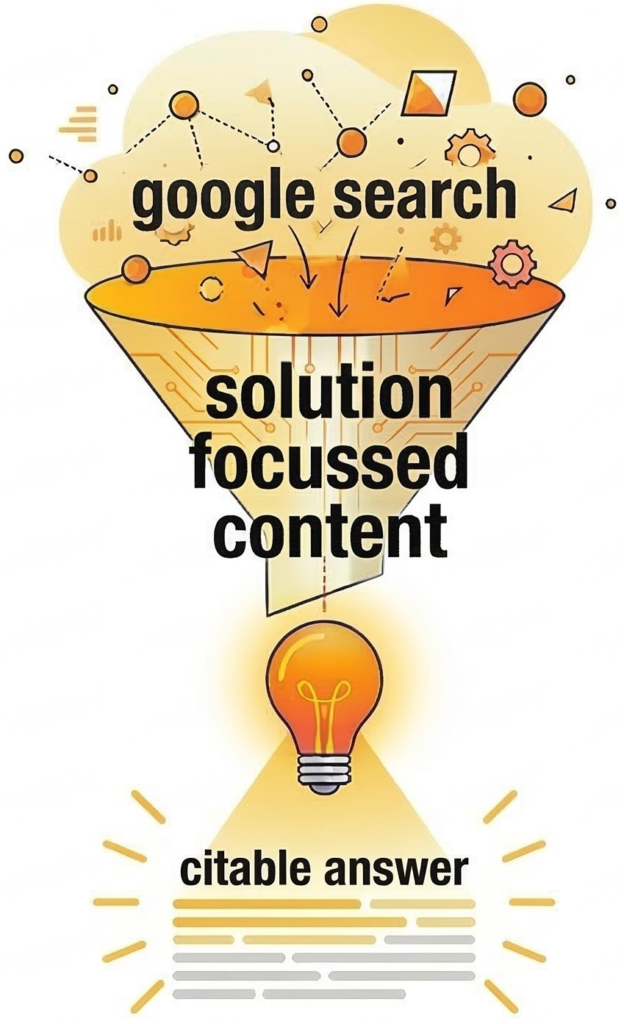
In the context of web content in 2026, we have moved from an “attention volume and specificity economy” to an “answer economy”. AI-powered systems like ChatGPT, Perplexity, and Google’s AI Overviews now provide synthesized answers directly on the results page. For your business to grow in this environment, you must shift from simply trying to “rank” to becoming the authoritative source that these AI systems cite and recommend.
The New Math of Digital Growth
Stats from the recent reports (Including VercelAEO) show why this transition is business-critical:
Zero-Click Dominance: Roughly 92% of searches with AI summaries result in no clicks to external websites.
Increased Bounce Rates:26% of users end their session immediately after reading an AI answer.
High Intent, High Conversion: While traffic may be lower, AI-referred visitors convert at 4.4x the rate of traditional organic search, as they have already been pre-qualified by the AI system.
Strategic Problem Solving: The Power of the Long-Tail
For scale-ups, competing for broad “head terms” (e.g., “Accounting Software for Start Ups”) is increasingly inefficient. The real opportunity lies in strategic problem-solving content targeted at long-tail search terms.
1. Target the "Conversational" Query
Users have swapped short, fragmented keywords for complex, contextual questions. Instead of “SEO tools,” they ask, “What is the best long-tail keyword research tool for a UK-based B2B SaaS?”. Long-tail keywords account for over 91% of all web searches and convert at significantly higher rates because they reflect specific, purchase-ready intent.
2. Solve Niche, One-of-a-Kind Problems
There is now more value in addressing highly specific problems, even if traditional ROI models didn’t previously justify it. AI engines prioritise “Information Density”. Every sentence should be a high-percentage play that leads to a resolution.
3. Structure Content for "Machine Understanding"
To be cited by an AI, your content must be easy to parse:
Answer First, Explain Later: Use the “inverted pyramid” model by leading with a direct, citable answer in your first 40–60 words.
Leverage FAQ Formats: Q&A structures align perfectly with how AI systems structure their own responses.
Modular “Chunking”: AI doesn’t index whole pages; it retrieves “chunks”. Keep paragraphs to 2–5 sentences that can stand alone as a complete thought.
Moving Forward: Adapt or Disappear
For companies looking to scale, visibility no longer means just ranking high, it means appearing directly in the answer itself. Brands that fail to optimise for this new paradigm risk fading into digital obscurity.
Shifting your tactics to cater to an answer economy is not optional, it’s existential.