
Humans are fundamentally changing how we digest information. Instead of browsing websites, we are asking AI platforms like Claude and Gemini to do it for us.
We are moving toward a world where AI agents, like Stripe’s autonomous procurement bots, will make purchasing decisions and purchases themselves directly from your site without a human ever looking at your homepage.
If your marketing strategy is built solely around human eyes and traditional Google clicks, you risk becoming invisible to AI platforms. To survive companies must transition from traditional SEO (Search Engine Optimisation) to SEO (Search Everywhere Optimisation), to be GEO, AEO, AIO ready.
But the good news is, if you are already well optimised for search engines, you have a good start.

AI bots do not care about your stunning web design, your colour palettes, or your typography. They care about structure, speed, and accessibility.
Although they don´t assess your design, the do assess your content, in detail. And they are fundamentally using the same structured data as Google uses to analyse your site.
So what´s the difference?
Recent research into LLM (Large Language Model) schema and accuracy reveals that AI models only interpret website content accurately between 16% and 50% of the time. If an AI assistant misunderstands your product, it will present incomplete, or inaccurate information to a potential buyer. It may even omit your brand entirely from its recommendations.
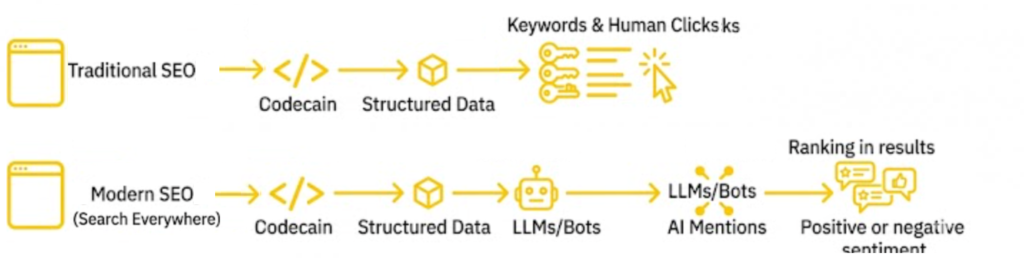
Schema lives in the backend of your website. It acts as an explicit set of instructions for LLMs, mapping out exactly what your data means. Think of it as a rich snippet built for AI consumption.
AI engines need to process your site instantly. By utilizing tools like Yoast to build a unified, connected schema map across all pages, an LLM can parse and connect your data in under 100 milliseconds.
If you don´t have your internal linking sorted out, this is the first and most impactful change you can make to improve your AI mentions.
While accessibility standards (like alt text and clean HTML structures) are vital for human inclusivity, they are now just as critical for bot readability. Without deep technical health, your content cannot feed into GEO (Generative Engine Optimisation) or AEO (Answer Engine Optimisation).

Despite the rise of AI assistants, traditional Google search is far from dead. It grew by 20% over the last year and continues to climb. More importantly, AI tools use Google’s indexes to process and verify real-time information.
SEO is not competing with AI search, it is the exact foundation that AI search was built on. If your site lacks core SEO health, you will fail to surface in both traditional search results and AI assistant recommendations.
AI engines are increasingly answering user questions directly within their own interfaces, resulting in “0-click content” that sends zero referral traffic to your site. To break through, you must shift your keyword and content architecture from broad definitions to high-intent, bottom-of-funnel value.
To capture your visibility in this new landscape, you must align your content with the specific intent driving each query. Understanding the distinction between these search types allows you to build targeted pages that capture prospects at every stage of their decision-making process. The matrix below outlines how these intent types map directly to your conversion funnel to maximise strategic ROI.
| Search Intent Type | Purpose | Funnel Position |
|---|---|---|
| Informational | Answering broad questions | Top of Funnel (High volume, low conversion) |
| Navigational / Brand | Finding a specific company | Mid Funnel |
| Commercial | Investigating solutions/reviews | Mid-to-Bottom Funnel |
| Transactional | Ready to purchase/request demo | Bottom of Funnel (Highest ROI) |

The classic marketing mistake is scattering generic blog posts across random topics at the top of the funnel. This drives superficial traffic that fails to convert. For a scaling business, your content architecture must be built from the bottom of the funnel up.
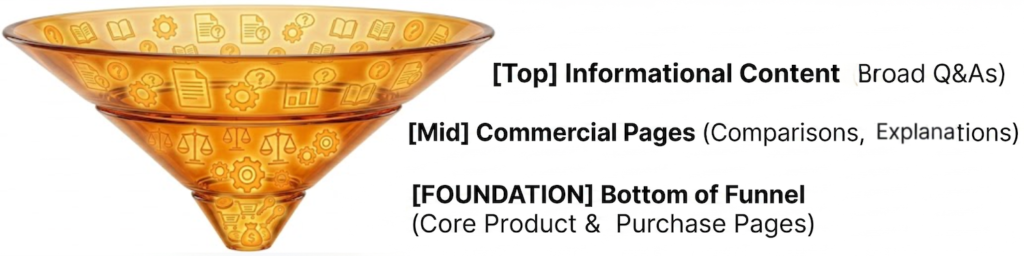
Build your core product, service, and purchase pages first. These pages pay the bills.
Do not scatter your focus. Pick one core product page and build a tightly knit cluster of content explicitly feeding into it. Every piece of higher-level content must link down to the transactional page beneath it.
Google and LLMs do not evaluate pages in isolation. If your site seamlessly covers the entire user journey, from initial curiosity to final transaction, search engines and AI bots recognise you as a trusted authority, lifting your rankings across the entire cluster.

AI writes remarkably well, but because it relies on existing public data, pure AI-generated content is fundamentally derivative.
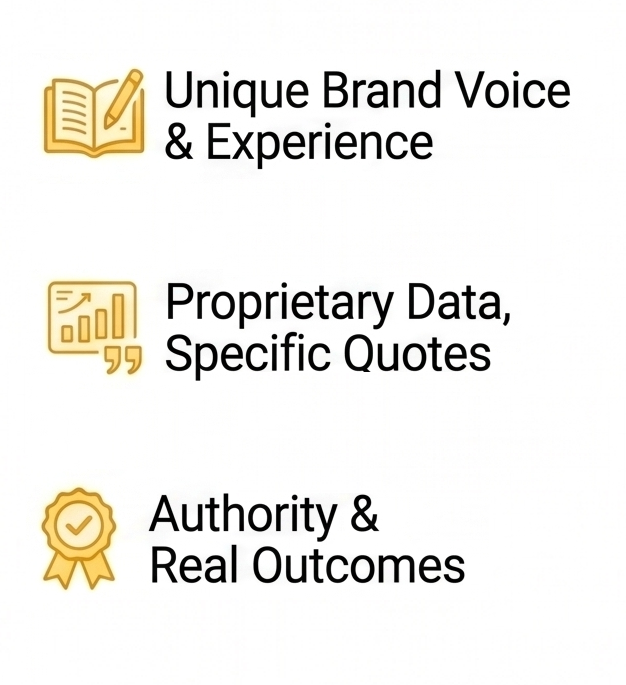
Currently, 96% of pages on the web get zero traffic from Google. The primary reason? They look and sound exactly like everything else. AI bots will not recommend unoriginal content because it offers no distinct brand voice, unique insight, or authority.
The Golden Rule of AI Utility: Use AI to assist, never to depend. Use it to optimise readability, generate technical schema, check metadata, or brainstorm the 30 specific questions a customer asks before buying. But always inject your company’s DNA, your proprietary data, contrarian opinions, client case studies, real outcomes, and specific executive quotes, into the final piece.

To capture both human clicks and AI bot recommendations, execute this two-phased organic growth strategy:
Create 10 to 15 exceptional, deeply researched pieces of content targeting specific long-tail, high-intent questions. Use robust internal linking within the body text to connect these clusters. Internal linking remains one of the highest effort-to-value ratios of any SEO tactic.
External link building is the hardest part of SEO, but links flow naturally when you publish original data or proprietary frameworks that people want to cite.
Leverage Journalist Networks: Monitor platforms where journalists post active queries looking for expert quotes and data points.
Provide Immediate Value: Respond persistently with highly specific insights. Securing high-authority editorial references establishes the ultimate trust signal for both Google algorithms and AI aggregators.

Tracking performance has become noticeably more complex. When an AI assistant recommends your company in a closed conversation, that data is stored inside their proprietary system. Current standard analytics cannot track the exact search terms or volumes happening inside LLM tools, nor can they cleanly isolate traffic arriving via an AI assistant.
However, modern tracking tools are evolving. Solutions like Yoast Premium’s AI Visibility Index now allow brands to monitor their footprint across selected AI channels. This framework measures:
Mentions: How often your brand is queried within LLMs.
Citations: How frequently the AI attributes information back to your site.
AI Brand Insights: The positive or negative sentiment associated with your brand across AI platforms.
At the moment, analytics are in their early days and we are working within a black hole. But the direction for Search Everywhere Optimisation strategy is clear, and the importance is only increasing.

Growth Marketing Specialist