
Companies often prioritise a design that reflects how they want the product to be seen rather than a framework that showcases what prospects need to see. It’s an easy trap to fall into because you live and breathe your own product, but you are not your buyer.
If your website is getting the traffic, but not generating sales calls or demos this article may help you understand why, and how to fix it.

Before changing a single line of copy, shifting a call-to-action, or redesigning a menu, you need to understand the exact tipping points that drive your audience to take action.
You can’t just guess what their problems are, you have to go out and ask them. When you talk to your current clients you begin to uncover the real triggers that made them look for a solution in the first place, along with the specific hurdles they faced along the way. Listening to the actual vocabulary they use allows you to mirror those exact phrases on your site, making your messaging more relatable.
Once you pair these human insights with the cold, hard numbers in your website analytics you get a clearer picture of what needs to change
Find out the exact problem they were trying to fix, how they attempted to solve it previously, and the specific trigger or “tipping point” that made them finally seek a solution.
Mirror the exact words, pain points, and motivations your clients share. If your website speaks in generic corporate jargon while your buyer talks in specific operational headaches, you lose them.
Find out what their barriers to purchasing were. What they had to overcome before a their first paid trial or signed agreement. Reflect this in your FAQs, in your onboarding information, reduce their concerns before they even contact you.

When a qualified prospect lands on your site, their path to understanding and conversion should be completely effortless. If your product targets both B2B and B2C clients, for example, you shouldn’t force them to untangle a single homepage, split them immediately using distinct visual styles or colour schemes so they know they are in the right place.
Instead of hiding behind generic stock photography, show them what you’ve built by using clean, conceptual images of your product. You are a scale up, not a well known and trusted brand, stock images will not build trust, images of of product will.
You also want to pre-empt the questions that your sales team hear repeatedly on demos. If a prospect can’t easily find out how much time, money, or internal resources it takes to get your system up and running, or the tech set up, they won’t reach out to ask they will simply go to a competitor who makes that commitment clear from the start.
Use clean navigation and a simple, instantly understandable value proposition. If you target multiple distinct audiences, segment them immediately, use visual cues or colour coding so visitors know exactly which door to walk through.
Instead of generic stock photos, use high-fidelity screenshots or simplified conceptual images of your dashboard. Show the product in action in a warehouse, show it coming off the production line. Let prospects visualise your product’s actual capabilities.
Ask your sales team what questions repeatedly come up on discovery calls. If prospects can’t find those answers on your website, they won’t guess, they’ll just leave, costing you valuable leads.
Make it exceptionally easy for visitors to see the investment required. Address onboarding times, time-to-value, and pricing structure early.

Getting your B2B website to successfully convert leads, isn’t about volume of traffic. It’s about quality of visitors. Don’t be afraid to filter out the wrong people.
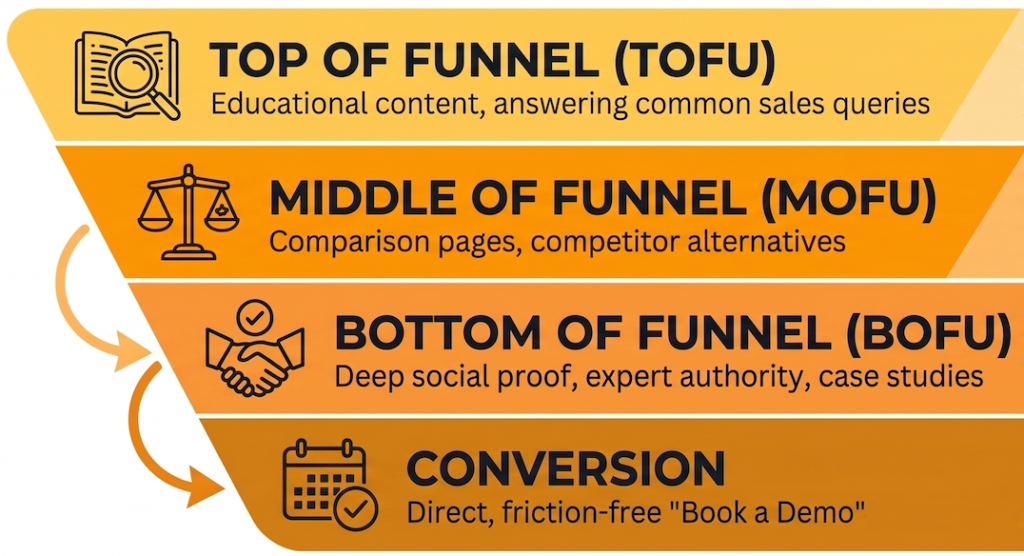
Target your comms for your ideal buyers. Understand that each prospect will be at different stages of readiness to buy, your content needs to meet them exactly where they are in their journey.
At the top of the funnel, you use focused themes to answer their broadest questions. Move into comparison pages in the middle funnel, and building deep trust with expert authority at the bottom.
Understanding this flow also changes how you view your conversion assets, particularly when it comes to gated content.
Many B2B companies celebrate when a white paper or webinar gets hundreds of downloads, treating them as sales-ready leads. This is a mistake. Most of the time, someone downloading a white paper has zero immediate intent to buy your product, they just want the data.
Similarly, webinar attendees usually sign up to learn about a broader industry trend, not your software. If they wanted to see your product, they would have booked a demo. Treat these as top-of-funnel awareness metrics, not qualified sales leads.

Beyond the overarching strategy and the psychological positioning of your brand, your site still has to nail the basic, technical mechanics of the modern web behaviour.
Everything from how your pages link together to how easily the text flows needs to feel intuitive. You are essentially designing a dual-purpose environment, it must feel entirely natural and scannable for human eyes, while remaining cleanly structured and accessible for search engine crawlers and AI bots that index your data.
A slow-loading page or an erratic layout will instantly kill a buyer’s trust, no matter how brilliant your copy is.
Clear typography and prominent, high-contrast CTAs that stand out naturally.
Intuitive internal linking between educational blog themes and bottom-of-funnel conversion pages.
Copy that is effortlessly readable for human eyes, but structured perfectly for AI crawlers and search engine bots.
Lightning-fast load speeds and flawless responsive design across all devices.
By shifting your website from an ideological corporate brochure to a customer-centric conversion engine, you stop wasting traffic and start filling your sales pipeline with buyers who are actually ready to talk.

Never underestimate the importance of a good structure in your website. If your ideal buyer lands on your website and can easily find what they need, the conversion to a sales conversation happens much more naturally.
The trick is in designing the website to reflect what they need to see, when they need to see it.

Growth Marketing Specialist